Inbound SIP
Inbound SIP lets a SIP client, such as a softphone or a SIP trunk, call one of your Turn.io numbers. Turn answers these calls the same way it answers that number's WhatsApp calls: with the AI agent, the waiting room or an operator in the inbox.
This page is for people who configure SIP clients. It covers the server, credentials, TLS, SRTP and codecs Turn expects, and how a call behaves once it connects.
Inbound SIP is in alpha and subject to change. Requirements, limits and behaviour may change in future releases.
Inbound SIP is behind a feature flag. To use it on your numbers, ask for access at support@turn.io.
At a glance
| Setting | Value |
|---|---|
| Server | sip.turn.io, port 5061 |
| Transport | TLS 1.2 or later, with an ECDHE cipher suite. No UDP or plain TCP |
| Authentication | SIP digest, MD5, qop=auth, realm turn.io |
| Username | The number's address, such as +15551230000 |
| Address to dial | sip:+15551230000@sip.turn.io;transport=tls |
| Media | SRTP keyed with SDES (a=crypto), profile RTP/SAVP |
| Codecs | G.711 μ-law (PCMU, payload type 0) or A-law (PCMA, payload type 8) |
| DTMF | RFC 4733 telephone-event, payload type 101 |
| Media ports | UDP 30000 to 30096, at the address in Turn's SDP answer |
| Direction | Inbound only |
Turning it on
- In Turn, open the number's Settings, then Calls, and find the Inbound SIP section. Only admins can change it.
- Switch on Enable inbound SIP.
- Under SIP password, click Generate and copy the password. It is shown only once: Turn keeps only a digest hash of it, so it can't show it again. You can type your own password instead. A new password replaces the old one straight away.
- Copy the SIP username. It is the number's address, including the leading
+.
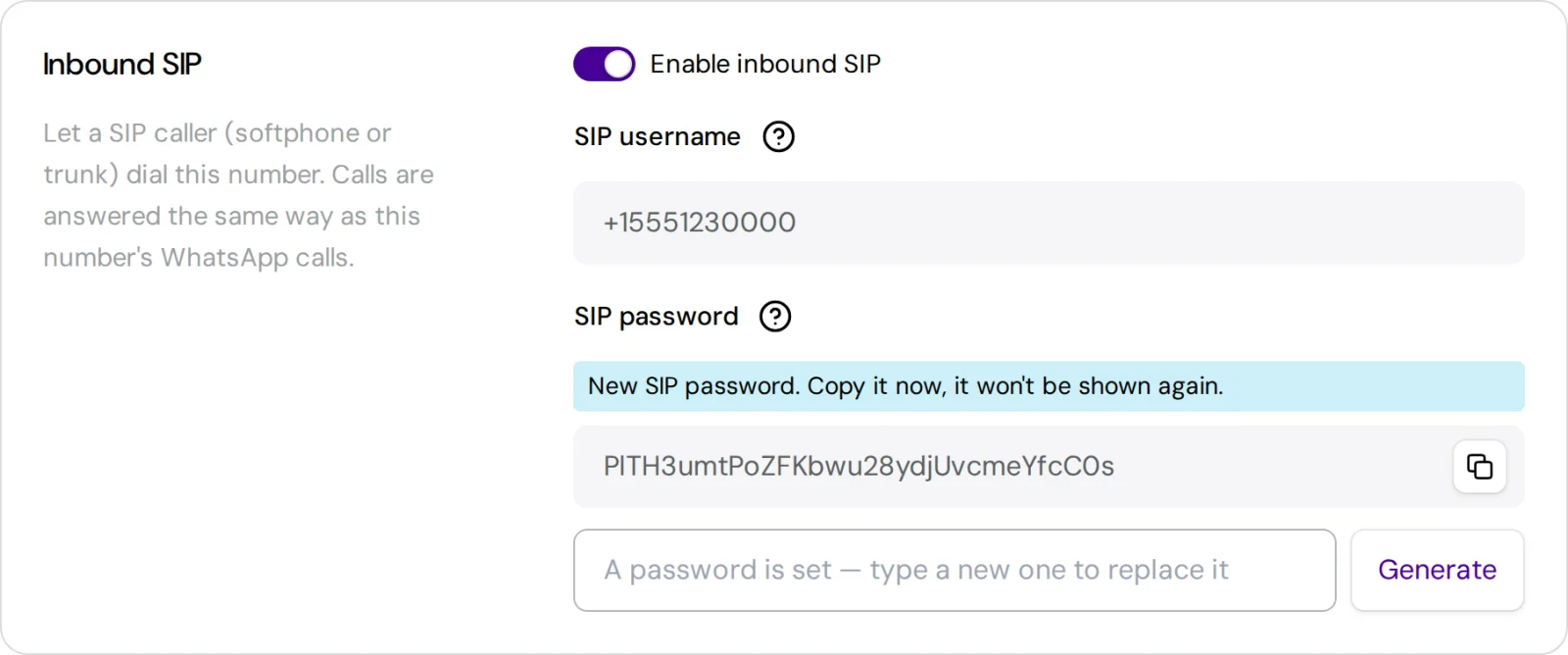
Until the number has a SIP password, Turn refuses its calls with 403 Forbidden.
The rest of the Calls page decides who answers: AI answering, the waiting room, appointments and operators. SIP calls follow the same settings as the number's WhatsApp calls.
Signalling
Server and TLS
Connect to sip.turn.io on port 5061 over TLS. Turn doesn't accept SIP over UDP or unencrypted TCP.
- Turn accepts TLS 1.2 and later, with forward-secret (ECDHE) cipher suites only.
- The certificate is publicly trusted and issued for
sip.turn.io. Verify it as you would any other. It's served whether or not your client sends SNI. - Turn doesn't ask for a client certificate.
- Keep the TLS connection open for the whole call. Turn sends its requests within the call, such as the
BYEwhen the AI agent ends the call, over the connection yourINVITEcame in on. It never opens a connection to you, so your client doesn't need to be reachable from the internet. - A connection that carries no signalling for an hour is closed. If your calls may last longer, send
OPTIONSkeep-alives. Turn answersOPTIONSwith200 OKwithout asking for credentials.
Authentication
Turn challenges every INVITE with 401 Unauthorized:
WWW-Authenticate: Digest realm="turn.io", nonce="…", qop="auth"
Answer the challenge with these credentials:
| Field | Value |
|---|---|
| Username | The SIP username from Turn, such as +15551230000 |
| Password | The SIP password you generated or set |
| Realm | turn.io |
Turn doesn't authenticate by IP address, so it doesn't need to know where your calls come from. On a SIP trunk, set Turn up as a peer that you authenticate to with these credentials.
Registration is optional. Turn accepts a REGISTER for the number's address (the SIP username as the address of record) with the same credentials and answers 200 OK. It never places calls to a registered client, so register only if your client insists on it.
Addressing
Two parts of the INVITE matter:
- The Request-URI user part chooses the Turn number. It must match the number's SIP username exactly, including the
+:sip:+15551230000@sip.turn.io;transport=tls. An address that matches no number gets404 Not Found. A number with inbound SIP switched off gets403 Forbidden. - The
Fromuser part is the caller. It must be a phone number: digits with an optional leading+, ideally in E.164 format. Turn files the call under the contact with that number, and creates the contact if it doesn't exist, as it does for a WhatsApp call. Anything else, such asalice, gets400 Bad Request.
A SIP trunk normally puts the caller ID in From, which is what Turn expects. A softphone normally puts its account username there. With the Turn SIP username as the account username, calls are filed under the number's own address. To call in as a different phone number, set the softphone's account username to that number and its authentication username (often called "auth ID" or "auth user") to the Turn SIP username. Leave registration off, because only the number's own address can register.
Media
SRTP
SRTP is required. Offer RTP/SAVP (or RTP/SAVPF) with SDES keys in a=crypto lines (RFC 4568). The keys travel inside the TLS-protected signalling.
Turn takes the first a=crypto line in your offer that it supports and answers with one line, carrying the same tag and suite and a key of its own. It supports these suites:
AES_CM_128_HMAC_SHA1_80AES_CM_128_HMAC_SHA1_32AEAD_AES_128_GCMAEAD_AES_256_GCM
Turn skips lines it can't honour exactly: an unknown suite, a key with an MKI (|1:4) or more than one key, or session parameters such as KDR or UNENCRYPTED_SRTP. A key lifetime is fine. Offer at least one plain line, such as:
a=crypto:1 AES_CM_128_HMAC_SHA1_80 inline:<base64 key and salt>
Turn refuses these offers with 488 Not Acceptable Here:
- Plain RTP (
RTP/AVP), even witha=cryptolines. SRTP is negotiated by the profile on them=line. - DTLS-SRTP (
UDP/TLS/RTP/SAVPwith a fingerprint). RTP/SAVPwith noa=cryptoline Turn can use.
Turn doesn't send or read RTCP.
Codecs
Turn speaks G.711 only. It answers with the first of PCMU (payload type 0) and PCMA (payload type 8) in your offer's order, plus telephone-event (payload type 101). Other codecs in the offer are fine, but Turn won't pick them. An offer with neither G.711 law, such as Opus or G.722 only, gets 488 Not Acceptable Here.
- Send 20 ms packets. Turn sends 20 ms packets.
- The
INVITEmust carry the SDP offer. AnINVITEwithout one (a late offer) gets488 Not Acceptable Here. - Turn accepts RFC 4733 DTMF but doesn't act on keypresses.
Here is an offer Turn accepts, and its answer:
m=audio 40000 RTP/SAVP 8 0 101
a=rtpmap:8 PCMA/8000
a=rtpmap:0 PCMU/8000
a=rtpmap:101 telephone-event/8000
a=crypto:1 AES_CM_128_HMAC_SHA1_80 inline:<your key>
a=ptime:20
a=sendrecv
c=IN IP4 203.0.113.11
m=audio 30012 RTP/SAVP 8 101
a=rtpmap:8 PCMA/8000
a=rtpmap:101 telephone-event/8000
a=crypto:1 AES_CM_128_HMAC_SHA1_80 inline:<Turn's key>
a=sendrecv
Ports, NAT and firewalls
- Send your audio to the address and port in Turn's SDP answer. The media address isn't the address
sip.turn.ioresolves to, so allow outbound UDP to the answer'sc=address on ports30000to30096. Each call gets one port in that range. - Turn uses symmetric RTP: it sends its audio to the address and port your audio comes from, not to the one in your SDP. A client behind NAT works without STUN or ICE, as long as it sends and receives on the same port. Turn doesn't use ICE.
- Send RTP continuously from the moment the call is answered, including during silence. Turn hangs up a call when it receives no audio for 30 seconds. Switch off silence suppression (VAD), and don't put the call on hold in a way that stops your RTP, such as
a=inactive.
Call flow
Client                                     Turn
  |------ INVITE (SDP offer) ---------------->|
  |<----- 401 Unauthorized -------------------|
  |------ ACK ------------------------------->|
  |------ INVITE (SDP offer, credentials) --->|
  |<----- 100 Trying -------------------------|
  |<----- 180 Ringing ------------------------|
  |                … ringing …                |
  |<----- 200 OK (SDP answer) ----------------|
  |------ ACK ------------------------------->|
  |<========== SRTP, both directions ========>|
  |------ BYE (or Turn sends BYE) ----------->|
  |<----- 200 OK -----------------------------|
- Ringing. After authenticating the call, Turn sends
180 Ringingwithout SDP, so play ringback locally. There is no early media. - Answering. Turn sends
200 OKwith its SDP answer as soon as something picks up: the AI agent, an operator accepting the call in the inbox, or the waiting room. In the waiting room the caller hears the welcome message and then hold music until an operator joins. - Nobody answers. Turn ends a call that nobody picks up 30 to 40 seconds after the
INVITE, with503 Service Unavailable. - Cancelling. A
CANCELwhile the call rings gets487 Request Terminatedfor theINVITE. - Hanging up. Either side can send
BYE. Turn sends one when the AI agent or operator ends the call, or when your audio stops for 30 seconds. - Re-INVITE. Turn accepts re-INVITEs that refresh the session, move your media address or re-key SRTP. The codec stays the same. If Turn can't accept a re-offer, it answers
488 Not Acceptable Hereand the call carries on unchanged.
Who answers
SIP calls are routed exactly like the number's WhatsApp calls, using the settings on the Calls page:
- AI answering: the AI agent picks up straight away, or when no operators are available. AI agents on OpenAI or ElevenLabs can answer SIP calls. A number whose AI answers with a Gemini model refuses SIP calls with
503 Service Unavailable. - Waiting room: the caller waits, with the welcome message and hold music, until an operator joins.
- Appointments: a caller with an appointment at the time of the call waits in the waiting room until the appointment's host joins.
- Operators: the call rings in the inbox like a WhatsApp call, in the caller's chat. If calls go to the chat's assigned operator, only that operator is rung.
The call appears in the caller's chat as it would for a WhatsApp call.
Response codes
| Code | Meaning |
|---|---|
100 Trying | Turn received the INVITE. |
180 Ringing | The call is authenticated and ringing. No SDP. |
200 OK | The call was answered. Carries Turn's SDP answer. Also the answer to a successful REGISTER. |
400 Bad Request | The From user part isn't a phone number. |
401 Unauthorized | Digest challenge. Send the request again with credentials. |
403 Forbidden | Inbound SIP is off for the number, or the number has no SIP password. |
404 Not Found | No Turn number has the dialled address. |
487 Request Terminated | You cancelled the INVITE while it rang. |
488 Not Acceptable Here | Turn can't use your SDP offer: it's missing, has no G.711 codec, isn't SRTP, is DTLS-SRTP or has no usable a=crypto line. In answer to a re-INVITE, Turn refused the change and the call continues. |
500 Server Internal Error | Turn couldn't set the call up. |
503 Service Unavailable | Nobody answered in time, the call couldn't be connected, or the number answers with an AI model that can't take SIP calls. |
603 Decline | An operator declined the call. |
Client checklist
Most failed calls come down to one of these settings:
| Setting | Value |
|---|---|
| SIP server or proxy | sip.turn.io:5061 |
| Transport | TLS |
| Username, or authentication username | The Turn SIP username, such as +15551230000 |
| Password | The Turn SIP password |
| Realm | turn.io, or leave it empty to take it from the challenge |
| Number to dial | The Turn SIP username |
Caller ID (From user) | The caller's phone number |
| Media encryption | SRTP with SDES, mandatory. Not DTLS-SRTP or ZRTP |
| Codecs | PCMU and/or PCMA enabled |
| Packetisation | 20 ms |
| DTMF | RFC 4733 |
| Silence suppression (VAD) | Off |
| Registration | Optional |
Limitations
- Inbound only: Turn doesn't place SIP calls.
- G.711 only. No wideband codecs such as Opus or G.722.
- SDES-keyed SRTP only. No plain RTP and no DTLS-SRTP.
- Keypresses are received but not acted on.
- No early media, and no setting for how long a call rings before Turn ends it.
- A number whose AI answers with a Gemini model can't take SIP calls.
- Capacity is limited during the alpha. Tell support@turn.io your expected peak of simultaneous calls before you send production traffic.